Devlog 007 / Tuning
Custom ECU Mapping
*Generated by AI.
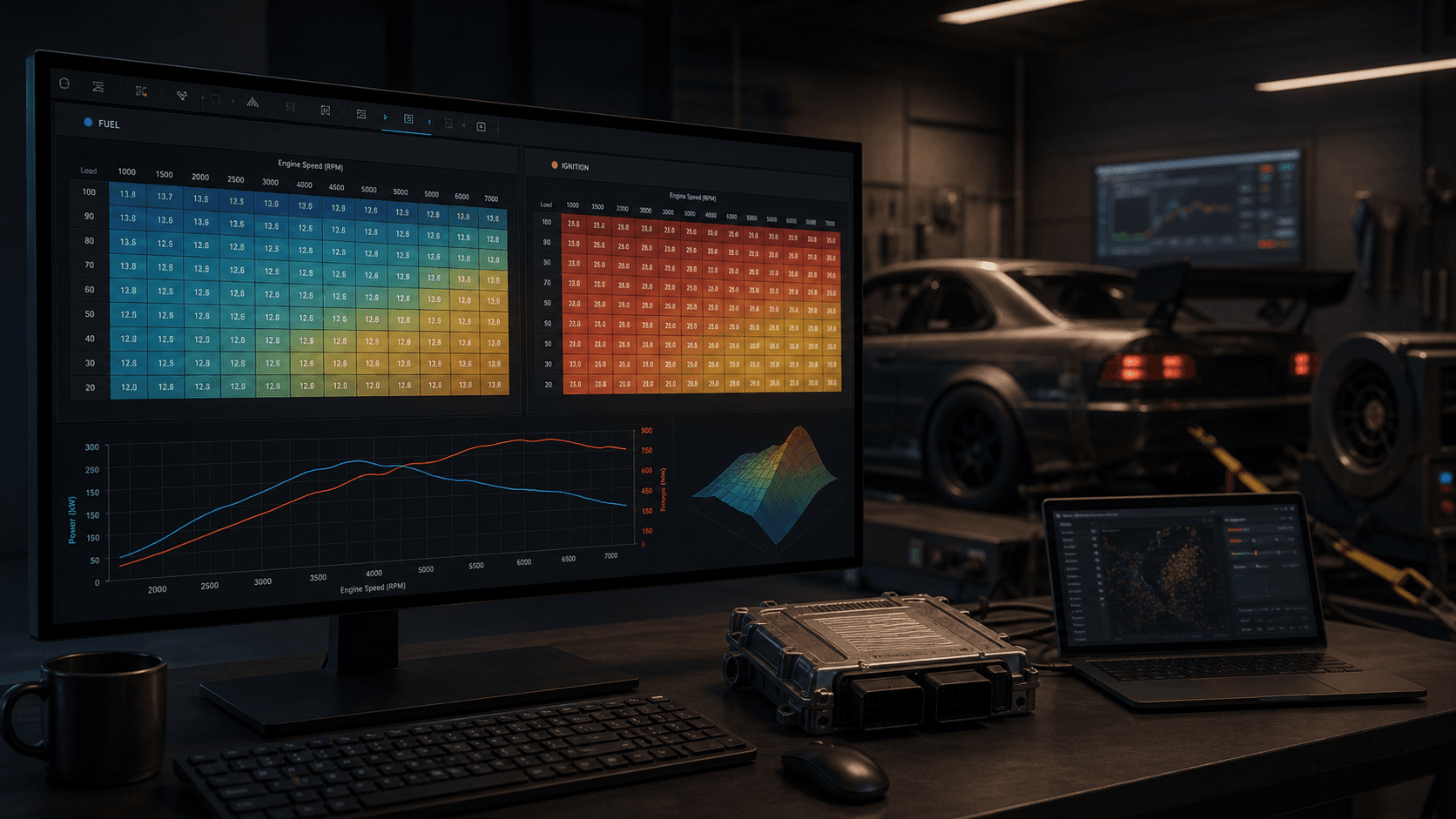
An ECU tune should do more than move a power slider. In Project Tourge, custom mapping gives the player control over how the engine is fuelled and when ignition happens across different parts of the rev range and under different amounts of load.
The goal is to make engine tuning understandable, useful and grounded in the same ideas as real calibration—without asking every player to become a professional tuner before they can enjoy their car.
Reading the engine as a map
An engine does not need the same calibration everywhere. Cruising gently at low engine speed is different from using full throttle near the top of the rev range, and a boosted engine adds another condition again. That is why the ECU workspace is arranged as maps rather than a single global setting.
One axis follows engine speed while the other represents engine load. Each cell describes what the ECU should do in that part of the engine's operating range. Selecting a cell lets the player change that area without rewriting the behaviour of the entire engine.
Project Tourge currently exposes two main maps: fuel mixture and ignition timing.
The fuel map controls the target air-fuel mixture. Adding more fuel creates a richer mixture, while reducing it creates a leaner one. Neither direction is automatically better. Moving too far away from what the engine wants costs torque, so filling every cell with an extreme value will not create a shortcut to maximum power.
The ignition map controls when combustion is started. A careful amount of advance can improve torque, but pushing too far introduces knock and the engine loses performance. Retarding the timing offers a safer calibration at the cost of some response or power. The useful tune sits between those extremes and can change depending on engine speed and load.
Seeing what a change does
The maps are connected to the tuning dyno. When a player selects part of a map, the graph provides feedback for that operating area, making it easier to understand whether the change helped or hurt.
This matters because ECU tuning should be about reading a result, not copying the largest-looking number. A good full-throttle calibration may improve the part of the rev range used during a pull, while a road-focused tune can also pay attention to how the engine behaves away from full throttle.
The factory calibration is always the reference. It is visible beside the edited values, and each map can be reset if an experiment goes in the wrong direction. The stock tune is intended to work properly. Custom mapping is an opportunity to refine a build, not a repair job every player is forced to complete.
The ECU cannot replace hardware
Mapping works with the parts installed on the engine. It does not allow software to invent a larger turbocharger, different camshafts or stronger engine hardware.
More capable ECU upgrades unlock more control. Depending on the build, that can include additional engine settings, limited boost adjustment, launch-control configuration and boost management in the lower gears. Even then, the available range remains tied to the equipment on the car. Changing hardware is how the player makes a large mechanical step. Mapping is how they make that hardware work together more effectively.
That boundary is important for both realism and balance. It keeps the upgrade system meaningful and prevents one tuning screen from making the rest of the engine build irrelevant.
Saving and reusing tunes
Saved ECU tunes belong to the player profile rather than the individual car. A player can give a calibration a name and keep it in their tune library independently of the vehicle on which it was created.
That separation protects the time put into tuning. Selling the car does not sell or delete its saved calibration, so the player can keep the tune, revisit it later and apply it to another compatible build. Saved tunes can be loaded when comparing ideas, returning to an older setup or testing a different direction. They can also be removed from the library without changing a calibration that has already been applied.
A preset remembers the engine it came from, and when it is used with another build the game only applies settings that the destination supports. Hardware restrictions still win, so loading a tune cannot bypass parts that are missing from the car.
This makes experimentation less destructive. A player can keep a reliable road tune, build a more aggressive version for a particular car and move between them without rebuilding every cell from memory.
Real concepts, controlled depth
The system is not trying to reproduce every page found in professional ECU software. Real calibration can include many more correction tables, sensor strategies, transient conditions, environmental compensation and safety layers. Recreating all of that would add complexity that is difficult to communicate and would give a very small group of players an enormous advantage.
Project Tourge keeps the relationships that matter to driving: engine speed, load, mixture, ignition, boost, knock and the hardware fitted to the car. Some of that behaviour is simplified and the useful adjustment windows are deliberately controlled.
An advanced player who understands engines should be able to find an advantage. They may produce a cleaner curve, make better use of a modification or shape the delivery for the way they drive. That knowledge should be rewarded—but the result should not leave a player using a sensible factory tune hopelessly far behind.
The difference should come from understanding and refinement, not from discovering a hidden combination that doubles the value of every installed part.
A strong tune completes a build. It does not replace one.
Development archive