Devlog 001 / Project
Welcome to Project Tourge
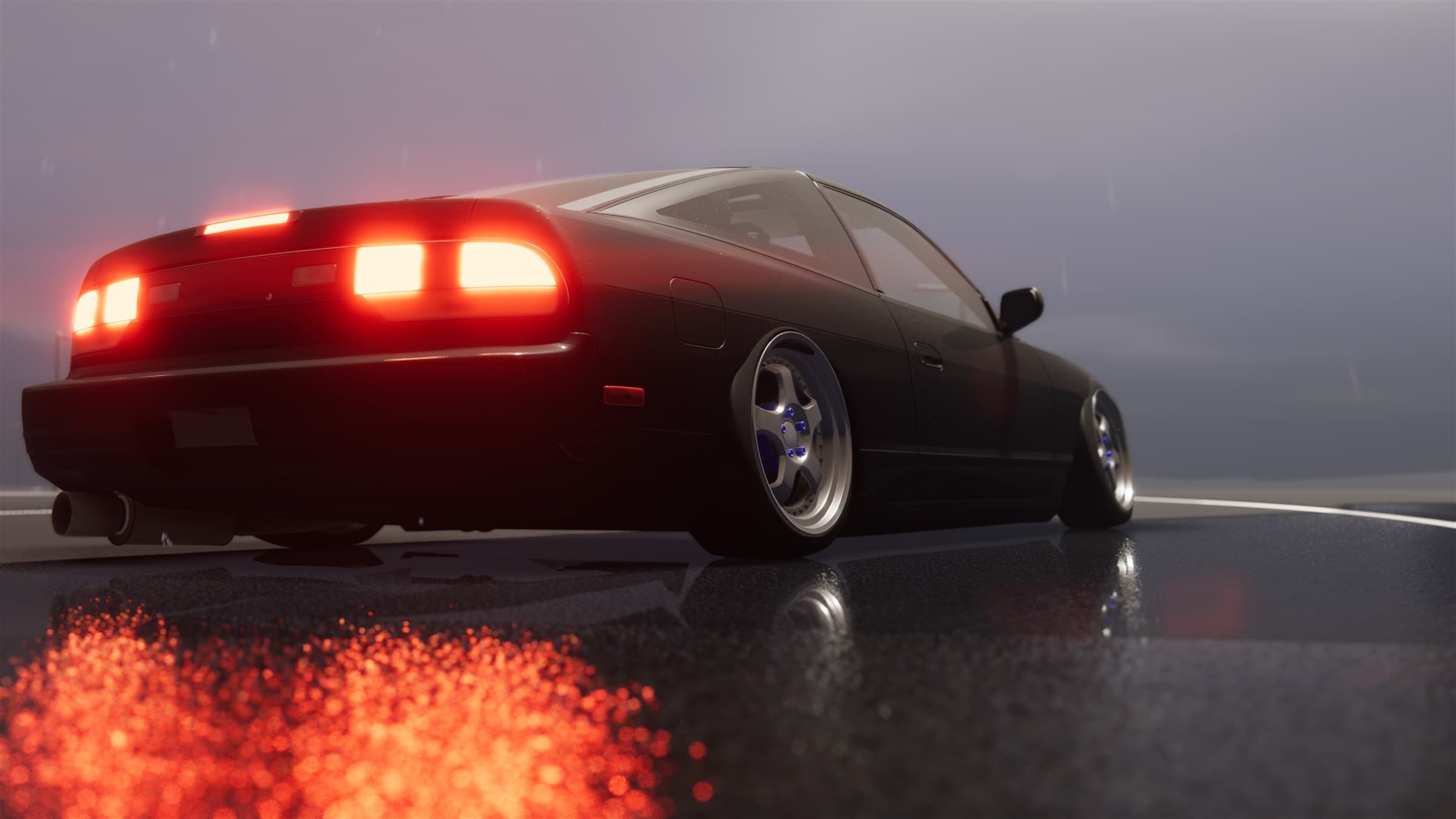
Project Tourge is an open-world racing game about owning a car, understanding it and building it into something that feels personal. It is a simcade game leaning toward simulation: approachable enough to jump into for a casual drive, but built on vehicle physics that will not drive the car for you when you start pushing its limits.
That balance is the foundation of the project. We want the first few minutes behind the wheel to make sense because the car behaves like a car. We also want the hundredth hour to remain interesting because there is still more to learn about the vehicle, the road and your own driving.
The car you want, built your way
The ownership fantasy matters as much as outright speed. The idea is that players can work toward a car they actually want, buy it and keep developing it instead of treating every vehicle as a short stop on the way to the next unlock.
Upgrades and tuning are meant to create genuinely different builds. The same model could become a comfortable street car, a focused highway build, a drift car or something much more extreme. Parts change the vehicle itself, while setup changes how those parts work together. An engine swap can move a build in another direction again.
There will always be practical limits to the number of parts and combinations we can produce, especially as a small team. When we say the possibilities should feel unlimited, we mean there should not be one prescribed version of each car or one obviously correct setup. We want players to revisit the same car and keep finding new ideas for it. Visual customization is part of that goal, but it is still work in progress.
An open world made for driving
Project Tourge is not being built around a single kind of road or event. The world is intended to support street racing and drifting, but it also needs highways, technical roads, places to park, meeting spots and ordinary stretches where driving with no objective is the objective.
Sometimes the best session is not a formal race. It is choosing a route, testing a setup, taking photographs, meeting friends in a parking area or seeing where a road goes. We want the map to give players room to make their own fun instead of constantly directing them toward the next activity.
The long-term goal is a seamless relationship with that world. Normal driving should not be broken up by conventional loading screens. Loading is expected when launching the game and may appear around teleports or service locations such as garages, but moving through the open world should feel continuous.
Easy to drive, difficult to master
Casual players are welcome. Casual physics are not the goal.
A player should be able to get into a sensible road car and enjoy it without studying vehicle dynamics first. That accessibility comes from familiar behaviour: the car has weight, the tyres communicate what they are doing, and smooth inputs produce understandable results. Driving normally should feel natural because the underlying systems agree with one another.
Once the player asks more from the car, knowledge starts to matter. Braking technique, weight transfer, throttle control, gearing, tyre condition and setup all influence how close a driver can get to the limit. Going faster requires skill. Extracting everything from a heavily modified build requires more of both.
Player assists are there to make different controls and experience levels practical, not to replace the physics. Current options include an automatic transmission, Launch Clutch Assist, Clutchless Shift Assist, Soft Clutch Shift Assist and Auto-Clutch on Handbrake. They help with particular inputs while the car underneath them remains the same car.
Other systems belong to the vehicle rather than a global difficulty menu. ABS and traction control are tied to the car and its configuration. If the build does not have them enabled, a UI switch will not magically give them to it.
Convenience without arcade automation
We want useful quality-of-life features, but not at the cost of making the vehicle feel like a menu with wheels. Headlights and indicators are controlled by the player. Tyres do not replace themselves. Fuel is not an optional bar that can be ignored when it becomes inconvenient.
If a car runs out of fuel, the insurance company can recover it to a gas station—for a fee, naturally. If the player is stranded, cannot afford recovery and is too far away to reach fuel, the current design can create a soft lock. That consequence is intentional for now, although it is something we may reconsider after more testing. In multiplayer, there is also a wonderfully low-tech solution: invite a friend and ask them to push you to the station.
Those inconveniences are not there simply to punish the player. They make ownership, preparation and roadside services meaningful. The line we are trying to hold is simple: remove unnecessary friction around playing the game, but keep the consequences that make the car and the journey matter.
Buy once, play offline
Project Tourge is currently being built as a fully playable offline game. An internet connection should not be required to enter the world, drive your cars or use the main single-player systems. Online services should add multiplayer and integrations—not act as permission to use the game someone already bought.
The principle is straightforward: buy it once, keep it and continue playing it. I strongly dislike always-online games that can lock a legitimate owner out because a connection failed or a server disappeared. Players without reliable internet should still be able to own and enjoy Project Tourge without artificial restrictions.
Piracy is still a real concern for a one-person project. I will take reasonable steps to protect the game, while accepting that no protection is perfect and that determined attempts to crack a game are extremely difficult to stop completely. The aim is to avoid turning paying players into the people most inconvenienced by that protection.
This is the direction and policy today, not a promise that ignores every future problem. If serious technical, platform or security issues appear during development, parts of the approach may need to change. I would only want to make that change for a strong, clearly explained reason. For now, the goal remains unchanged: the complete single-player experience should work without an internet connection.
Offline and multiplayer, without changing games
Offline and multiplayer should feel like two ways of entering the same world. The goal is to remove the usual wall of menus and separate progression between them: invite a friend, join each other and continue driving.
The cars, builds, time, weather and important world state are shared so that meeting another player does not feel like loading into an unrelated mode. You should be able to cruise, race, drift, take photographs, compare builds or rescue the friend who forgot to buy fuel without the game deciding what the session must become.
Peer-to-peer multiplayer helps us keep that experience practical for a small project, though it has real limitations. Connection quality depends on the host and the route between players, and it cannot provide the same consistency as a worldwide dedicated-server network. The benefit is that players can create a room quickly while we avoid infrastructure costs that would be unrealistic for the project today.
Designed by a player
I am developing Project Tourge, but I am also designing it as someone who plays a lot of games. Years of driving, racing, drifting and modding have taught me what keeps me playing, what looks exciting from a distance but feels wrong with a controller in my hands, and which small frustrations can weaken an otherwise great experience.
The physics are not being built blindly. I have bought and studied multiple books on vehicle dynamics and related automotive subjects so I can understand the principles behind the systems I am creating. I also own a car and use that real-world experience as another point of reference: how its components work together, how the controls communicate weight and movement, and how the car responds when an input changes. Reading, observation, implementation and repeated testing all contribute to the result. Project Tourge is still a game, but its behaviour is being designed from research and understanding rather than guesswork.
I genuinely like CarX Drift Racing Online 2, but its steering rack implementation is not yet the moment where I can say, “Yes, that is exactly it.” I have also spent many hours playing and modding CarX games in general. They have given me plenty of inspiration, but their approach to controller steering assistance is not the direction I want for Project Tourge. Here, controller input should still feel connected to the car and its steering rack rather than feeling as though a drift system is making the important decisions for the player.
Forza Horizon is another good example. I love the atmosphere, the freedom and the feeling of entering a large automotive playground, but its physics are not the target for this project. Need for Speed has delivered memorable car audio, presentation and customization, but its physics and controls are also not what I want Project Tourge to become.
That does not mean those games are bad, and it does not mean I want to copy their strongest parts. It means I can study why a successful idea works, understand why another part does not fit my taste, and then build something in my own style. The goal is not to make another CarX, Forza or Need for Speed. It is to create the combination I still want when I put the controller or wheel in my hands: an inviting open world, cars with personality, meaningful customization, strong sound and presentation, and physics that continue to reward the player as their knowledge grows.
Being an independent solo developer creates obvious limits, but it also gives Project Tourge a different kind of freedom. Large games may have manufacturers, publishers, investors, broad audiences and long approval chains influencing what can be built or changed. I do not have their teams, budgets or access to licensed material, but I can pursue unusual ideas, keep systems that ask more from the player, and change direction when something simply does not feel good enough. Every system still has to survive testing and fit the game as a whole. Independence is freedom, not an excuse.
Official licenses are out of the question for this project. Players should not expect licensed cars, manufacturers, branded parts or a licensed soundtrack. Project Tourge has to build its own identity with the resources available, and I would rather be transparent about that than imply something the project cannot deliver.
Immersion within our reach
Project Tourge aims for detailed graphics, convincing audio and as little game-like interruption as possible. Unity HDRP gives the project a strong visual foundation, but the final result is still limited by what I can create or source, the knowledge and hardware available to me, and the time I can put into it. I will keep pushing it while making sure the game can scale down for players who need lighter settings.
Right now, “our team” means one person. Project Tourge is designed, programmed and assembled by me. There are no dedicated vehicle artists, environment artists or map artists working on the project, and 3D art is currently one of its biggest limitations. Cars, roads, buildings, customization parts and the wider world all require specialist work, so their variety and production speed cannot match a fully staffed studio.
I am still trying to make the best game I can with the tools, assets, knowledge and time available to me. That means learning new disciplines, making careful use of what I have and focusing effort where it can make the greatest difference. It also means being honest when a rough asset, an unfinished area or a limited selection exists because there simply is not another artist available to solve it yet.
The same honesty applies everywhere else. This is an ambitious game made by one developer. The world, car list, customization library and online systems cannot begin at the scale of a large studio production. Some features are work in progress, some will change through testing, and some ideas may need to be reduced if they do not meet the quality I want.
You can find more of my work at krsls.dev.
What I can protect is the direction: cars with depth, an open world that respects free driving, consequences without arcade shortcuts, and a smooth path from driving alone to driving with friends.
Hop in casually when you want to. When you decide to go deeper, the car should be ready to meet you there.
Development archive